If you’ve ever driven past an industrial tower at rush hour, you’ve probably noticed something that feels messy at first glance: big, boxy structures tucked between warehouses, with semi-trucks idling at loading docks, forklifts weaving around pallets, and cars for office workers darting in and out. Back when I started in this line of work 10 years ago, I thought industrial towers were just tall storage units—nothing more, nothing less. Turns out, that’s totally wrong. These buildings don’t just hold goods, they control the traffic flow that keeps supply chains moving, and if we don’t get that right, whole operations grind to a halt. Industrial Tower

Let’s break this down like I would explain it to a friend over coffee, no stuffy jargon. First, let’s get clear on what “industrial tower traffic flow” even means here. It’s not just cars on a road. It’s three big groups all sharing the same space: semi-trucks hauling inbound or outbound freight, forklifts and pallet jacks moving stuff around the yard and inside the building, and the little vehicles—office vans, delivery cars, even maintenance scooters—for the people who work there. Get any one group wrong, and you’ve got backups: a semi stuck trying to turn into the yard, a forklift blocking a main path, an office worker almost getting hit by a truck. We’ve all seen those viral videos of port warehouses where a semi hit a forklift? That’s a traffic flow fail.
So how do we, as industrial tower suppliers, actually handle this? It starts way before we even break ground on a new tower. We don’t just draw up the building and call it a day. We do a site audit first, and that’s where most of the magic happens. Let’s say a customer calls us and says, “I need a tower for my e-commerce fulfillment center.” First, I don’t just nod and pick a standard size. I ask questions that most suppliers skip: How many semi-trucks do you unload every hour? Do your drivers come from local routes or cross-country (big difference in how they navigate a yard)? Do you have 50 forklifts or 200? Do your office staff mostly drive in, or is there a shuttle?
Last year, we worked with a customer in Atlanta that had a problem: their old tower had 12 loading docks, and they’d hit a point where they needed 22, but their yard was only big enough. They thought they’d have to move to a new property, but instead, we tweaked the yard layout. We added a “pre-sort loop” right off the main road—trucks don’t pull straight into the yard anymore; they circle that loop first to get assigned a dock. No more double-parking on the public road, which was a huge issue for the city because they were getting 311 calls every week from neighbors. Then, we split the yard into two zones: one for inbound trucks (dropping stuff off) and one for outbound (picking up finished goods). We put a physical divider—just a line of bollards and reflective tape, nothing fancy—so no one confused the two. That small change cut their wait time for trucks by 40% in the first month.
Now, inside the tower itself, traffic flow is just as critical. I’ve seen towers where forklifts and manual pallet jacks share the same aisles as foot traffic for workers picking orders. That’s a recipe for injuries. So we design the internal layout with “speed tiers.” The main aisles, the ones big semi trailers can even pull through (we call them “truck aisles”), are for the big stuff—outbound pallets, inbound freight. The smaller aisles are for forklifts moving through storage bays, and the narrowest ones are for pickers on foot or electric carts. We also put stop signs at every aisle intersection, and paint the floor different colors: bright yellow for forklift zones, green for picker paths, red for emergency exits. Simple, right? But it works. A customer in Dallas told us after we renovated their tower that they cut near-misses by 75% in three months.
Wait, let’s talk about the tech part, too. It’s not just paint and dividers anymore. A lot of people don’t realize industrial towers now have traffic management systems that talk to each other. We install sensors on forklifts that alert drivers when a truck is coming around a corner, and we have digital dashboards that customers use to see in real time where every vehicle in the yard is. Last year, we rolled this out for a big grocery distributor in Chicago. Before, they had a person sitting at a desk calling drivers on walkie-talkies, trying to assign docks. Now, the system does it automatically. If a dock frees up, the nearest semi gets a notification, no delays. That cut their detention time—meaning how long a truck sits idle at a dock—from 90 minutes to 22 minutes. That’s not a small number; that’s $10,000 a week they’re not wasting on idle driver pay and fuel.
But here’s the thing: one size doesn’t fit all. Some of our customers are small, family-owned businesses with just 2 loading docks and 5 forklifts. A big fancy sensor system would be overkill. For those, we keep it simple: wide enough aisles, clear signage, a dedicated spot for office cars to park so they’re not blocking the yard. We had a customer in Detroit that runs a small parts distribution business. They couldn’t afford a big tech setup, so we designed a small tower with a separate employee parking lot right next to the office entrance, so no one has to drive through the truck yard. We also added a “car only” lane off the public road leading to that lot. That fixed their problem where employees were cutting through the truck yard to get to the office, and drivers were getting mad because they had to swerve around cars. It’s basic, but it works for their needs.
We also have to plan for growth. Industrial towers aren’t static—customers add more trucks, more forklifts, more employees every year. So we build in flexible traffic spaces, not fixed. For example, we leave extra space in the yard for future loading docks, and the main aisles inside the tower are wide enough that if a customer buys more forklifts, they don’t have to do a full renovation just to make the aisles bigger. A lot of suppliers will build a tower to fit exactly what a customer asks for right now, but that’s short-sighted. We’ve had customers come back to us after 5 years, say they doubled their business, and we’re able to adjust the traffic flow instead of starting over.
Let me be real with you, though. It’s not just about buildings and systems. It’s about people, too. We train our customers’ teams on how the traffic flow works, not just hand them a key and say “good luck.” Last quarter, a customer in Phoenix had a new tower, and their driver team didn’t know the pre-sort loop, so 3 trucks ended up double-parked on the main road in the first week. We sent one of our guys out there for a half-day walkthrough, drove the loop with the drivers, and walked through the dock assignments. After that, no more issues. We don’t just sell a tower—we support the traffic flow long after it’s built.
Another common pain point we see is the last-mile stuff. A lot of industrial towers are near major highways, but the access road is narrow. So we work with local governments to adjust that access before we even start building. In Houston, we had a customer whose old tower had a 20-foot access road that couldn’t fit two semi-trucks passing each other. That caused backups every afternoon during shift change. We talked to the city, got a permit to widen the road to 30 feet, and added a “yield for trucks” sign. That fixed the problem for everyone, not just the customer. It’s a win-win.
Wait, let’s talk about a mistake I see a lot of new industrial tower suppliers make. They only focus on the big vehicles—semi-trucks—because that’s where the money is, but they forget the small stuff: delivery vans, maintenance trucks, even the electric carts workers use inside. Those little vehicles cause just as many traffic jams if they’re not accounted for. So we design dedicated spots for those, too—like a small drop-off zone for Amazon vans, or a lane for maintenance trucks to park without blocking forklifts. A customer in Miami told us their old tower had no spot for their HVAC maintenance truck, so the driver would park in the middle of the yard for an hour, and forklifts had to go around, causing backups. We added a 20×20 spot near the loading dock, and that problem was gone.
Let me wrap this up like I would if I was talking to someone who’s shopping around for an industrial tower. It’s not just about square footage or how high the building is. The traffic flow in and around it is what makes or breaks your operation. Too many suppliers treat that traffic as an afterthought, but for us, it’s the first thing we design. We do the site audit, map out every truck, every forklift, every employee, and build a system that works for your specific business, not some generic template. Whether you’re a small shop with 2 loading docks or a big fulfillment center with 50, we can adjust.
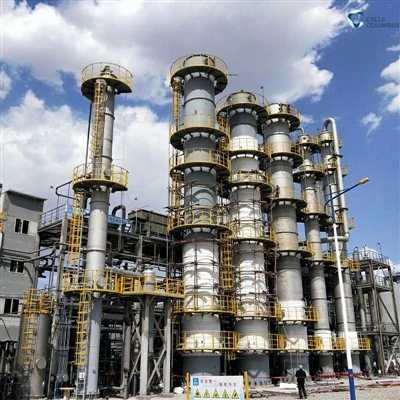
If you’re tired of dealing with traffic jams, idle trucks, or near-misses at your current industrial tower, don’t guess your way through it. Reach out to us to talk through your needs. We’ll walk through what you’re dealing with, no sales pitch, no confusing jargon, and give you ideas that actually work for your business.
Distillation Towers References
- National Institute for Occupational Safety and Health (NIOSH). Industrial Vehicle Traffic Flow and Safety in Warehouse Facilities, 2022.
- Council of Supply Chain Management Professionals (CSCMP). Yard Management Best Practices for Industrial Facilities, 2023.
- Occupational Safety and Health Administration (OSHA). Guidelines for Pedestrian and Heavy Equipment Traffic Separation in Warehouses, 2021.
Beijing Cycle Columbus Environmental Science & Technology Co., Ltd.
Beijing Cycle Columbus Environmental Science & Technology Co., Ltd. is one of the most professional industrial tower manufacturers and suppliers in China. We are committed to providing high quality customized products with competitive price. Please feel free to buy advanced industrial tower made in China here from our factory. Also, quotation is available.
Address: 1201, 12/F, Tower B, Bldg 8, Guancheng Garden, Haidian District, Beijing, China
E-mail: Info@saikekanglun.com
WebSite: https://www.cycle-columbus.com/
