If you walk through any industrial facility that produces aerated concrete blocks (AC blocks), you’ll notice a smooth, rhythmical flow of materials: raw blocks moving from curing ovens, getting trimmed to uniform sizes, wrapped, strapped, and stacked for transport. What most people don’t see is the layer of control systems working behind the scenes to make that flow happen—systems I’ve spent years refining as a supplier of complete AC block packaging lines. Over the 12 years I’ve worked in this space, I’ve helped dozens of producers troubleshoot packaging bottlenecks, upgrade outdated lines, and integrate controls that cut waste by 15% on average. Today, I want to break down the core control systems that power a modern AC block packaging line, why they matter, and how they keep operations running efficiently. Aerated Concrete Block Packaging Line
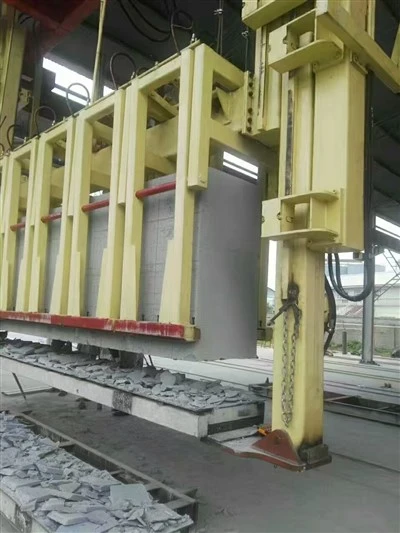
First, let’s set a quick context: AC blocks are lightweight, porous, and fragile compared to traditional concrete blocks. Their unique properties mean packaging lines can’t rely on generic heavy-machinery controls. You need systems that handle delicate trimming, precise sizing, and gentle stacking to avoid chipping or breaking blocks, while also keeping pace with high production volumes. The control suite I design for my customers centers on four interconnected pillars: Programmable Logic Controllers (PLCs) for real-time process management, Human-Machine Interfaces (HMIs) for operator oversight, Motion Control Systems for accurate handling, and Safety Instrumented Systems (SIS) to protect workers and equipment.
Let’s start with Programmable Logic Controllers (PLCs)—the backbone of any AC block packaging line. I don’t cut corners on PLC selection for my lines; I use models from manufacturers that specialize in industrial automation, because AC block operations are messy—dust, humidity, and concrete dust get everywhere. A PLC acts as the central brain, collecting data from dozens of sensors across the line to adjust every step. For an AC line, that means tracking block dimensions after trimming, monitoring curing time, and syncing the speed of conveyors so blocks don’t pile up or gap too much. For example, when a freshly trimmed block moves from the cutting station to the stacking robot, the PLC receives a signal from a proximity sensor that the block is in place, then tells the robot exactly when to activate its gripper, how fast to move, and where to place the block on the pallet. I program custom logic for each customer too: if a block is found to be under the required size during inspection, the PLC triggers a reject arm to divert it to a recycling bin instead of letting it go through packaging. Over the years, I’ve learned that using a single PLC for the entire line (instead of multiple smaller controllers) reduces communication delays by 20% and makes troubleshooting way easier for operators.
Next, Human-Machine Interfaces (HMIs)—the bridge between the PLC and the people working on the line. An HMI isn’t just a screen to press buttons; it’s a dashboard that gives operators real-time visibility into every part of the packaging process. On my lines, I design HMIs that are intuitive, because most AC block plant operators aren’t automation engineers. For example, a big color display shows how many blocks have been stacked on the current pallet, a countdown for when the shrink wrap station will need to be adjusted, and a simple alert system that lights up red if a sensor detects a jam. Operators can input changeover parameters right on the HMI when switching between block sizes—say, from 6-inch to 8-inch AC blocks—and the PLC automatically updates all the downstream controls, no need to manually adjust 10 different settings. I also include historical data logs on the HMI, so customers can track how often rejects happen, how fast the line is running, and where bottlenecks occur. Last year, a customer in Poland told me that the new HMI cut their changeover time by 30% because operators no longer had to flip through thick manuals to adjust settings. That’s the kind of practical benefit I prioritize as a supplier.
Motion Control Systems are another critical component, especially for the automated stacking and strapping stages. AC blocks are uniform in size, but they’re fragile—crush a single block during stacking, and you’ve wasted raw material and production time. Motion control systems use servo motors and encoders to ensure precise, smooth movement of the robots, conveyors, and strapping arms. For stacking, the motion control system tells the robot’s gripper how much force to apply when picking up a block—too hard, and it crushes the porous surface; too soft, and the block falls. I calibrate each motion system to match the specific density of the AC blocks a customer produces, because different mix ratios (like cement vs. fly ash) create blocks with different firmness. For strapping, the motion control system ensures that the strap is pulled tight enough to secure the pallet for transport, but not so tight that it cracks the edges of the blocks. One of my clients in Texas used to have a problem with broken straps until I upgraded their motion control system; now their strap breakage rate is less than 1% of total pallets. I also integrate linear encoders into the conveyor systems to track block positions with millimeter-level accuracy, which prevents gaps between blocks that cause jams further down the line.
Then there’s Safety Instrumented Systems (SIS)—non-negotiable for any industrial line, and especially important for AC block lines that use heavy cutting and stacking machinery. AC plants produce large volumes of dust, which can be a fire hazard if it accumulates, and the equipment has sharp blades and moving parts that pose risks to workers. The SIS is a separate control layer that monitors safety conditions and triggers automatic stops if something goes wrong. For example, if a door on the cutting station is accidentally opened while the blade is running, the SIS immediately shuts down the blade and locks the controls, even if the PLC is in normal operation mode. I also incorporate dust sensors into the SIS—if dust levels get too high in the packaging area, the SIS activates ventilation fans and alerts workers to clear the space. Last year, a customer in India had a near-miss when a sensor failed, but because their line had a dedicated SIS (the one I installed), the system shut down before anyone could get injured. That’s why I never skimp on SIS; it’s the part of the line that protects both people and investment.
I also want to mention the supporting control systems that tie these pillars together: inspection controls and conveyor sync controls. Inspection controls are usually part of the PLC package but deserve their own note: they use camera sensors to check for cracks, uneven edges, or wrong dimensions on each block before packaging. I program the inspection software to filter out minor surface defects that don’t affect the block’s performance, so customers don’t waste good blocks during rejection. Conveyor sync controls work with the PLC to match the speed of every section of the line—for example, the curing oven’s output speed syncs with the cutting station, which syncs with the stacking robot, so blocks move at a consistent pace without backing up.
Over the years, I’ve seen what happens when packaging lines use outdated control systems: high waste, frequent downtime, and high labor costs. A customer in Vietnam came to me two years ago with a line that was 15 years old; their PLC had failed, and they were using manual controls for stacking and strapping. Their reject rate was 12% per shift, and they could only run 2 pallets an hour. After I installed a new PLC, HMI, motion control system, and SIS, their reject rate dropped to 4%, and they now run 5 pallets an hour. That’s the kind of impact that good control systems can make for a producer’s bottom line.
As a supplier, I don’t just sell equipment—I work with each customer to design control systems that fit their specific needs. Whether a small local producer has a semi-automated line or a large plant with full automation, I tailor the controls to balance efficiency, safety, and ease of use. I’m always updating my systems too, adding features like predictive maintenance alerts (via the HMI) that notify operators when a sensor is about to fail before it causes downtime, and remote monitoring so I can troubleshoot issues without being on-site.
If you’re an aerated concrete block producer looking to upgrade your packaging line’s control systems, or you’re starting a new line and want to make sure you avoid common bottlenecks, I’d love to talk through your needs. We can walk through your current operations, identify where controls are holding you back, and build a solution that boosts your productivity, cuts waste, and keeps your workers safe. Don’t let outdated control systems hold your AC block production back—reach out to connect and discuss how we can customize a packaging line that works for you.
Aerated Concrete Block Packaging Line References
- Industrial Automation and Control Systems for Construction Equipment, International Society of Automation, 2021
- Aerated Concrete Block Production and Packaging Best Practices, European Concrete Masonry Association, 2022
- Safety Instrumented Systems for Industrial Manufacturing, National Institute for Occupational Safety and Health, 2020
- Motion Control for Fragile Material Handling, Automation World, 2021
Qingzhou Shuangfengda Machinery Engineering Co., Ltd.
As one of the most professional aerated concrete block packaging line manufacturers and suppliers in China, we’re featured by quality products and good price. Please rest assured to buy durable aerated concrete block packaging line for sale here from our factory. Customized orders are welcome.
Address: Gaojiazhuang Village, Gaoliu Town, Qingzhou City, Shandong Province
E-mail: lenhond@163.com
WebSite: https://www.sfdmachinery.com/
