If you’ve ever driven a car, used a power tool, or even ridden a bicycle, chances are you’ve interacted with grey iron casting—those sturdy, graphite-rich metal parts that form the backbone of countless industrial and consumer goods. As someone who’s run a grey iron casting supplier for over 15 years, I’ve learned that the success of every part we ship boils down to one thing: uncompromising quality control. Grey iron isn’t just molten metal poured into a mold; it’s a material with a unique set of properties (that graphite flake structure gives it excellent vibration damping and wear resistance) that demand equally unique checks at every step of the process. No two castings are identical, so cutting corners at any stage—from raw material receipt to final shipping—can lead to parts that fail down the line. Over the years, I’ve refined our QC steps through trial, error, and plenty of late nights troubleshooting rejects, and today I want to walk you through exactly what we do to make sure every grey iron casting leaving our facility meets both our standards and our customers’ needs. Grey Iron Casting
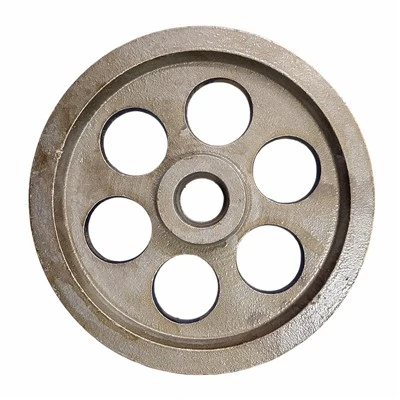
Let’s start at the very beginning, because the quality of a casting is set long before the metal ever touches a mold. The first line of defense is raw material inspection, and we don’t skip this step for anything. Grey iron is primarily made from pig iron, scrap steel, scrap iron, and sometimes small amounts of alloying elements like silicon, manganese, or copper to tweak its strength and hardness. A bad batch of raw pig iron can introduce impurities like sulfur or phosphorus that make the final casting brittle or prone to cracking, so we test every incoming load before it even gets stored in our yards. Our lab team runs a quick chemical analysis on each batch using a spectrometer—this tool zaps a small sample of the material and tells us the exact percentage of every element present, down to the tenths of a percent. For example, we need silicon levels between 1.8% and 2.5% for most of our standard grey iron grades, because too little silicon makes the metal hard and difficult to machine, while too much causes excessive shrinkage and porosity. We also check for moisture in scrap metal, because wet material can cause steam bubbles to form in the molten iron, leading to surface defects in castings. If a batch is even slightly off, we send it back right away—no exceptions. I’ve seen too many suppliers try to “work around” bad raw materials, only to end up with hundreds of defective castings that cost them way more in rework than they would have lost returning the load.
Once the raw materials pass inspection, the next step is melting and metal preparation, which is where we add even more checks to keep the metal consistent. We use an induction furnace for melting because it gives us precise temperature control—grey iron melts at around 1,200°C (2,192°F), so we monitor the temperature throughout the melting process to avoid overheating, which can make the metal too fluid and lead to casting defects. Right before we pour the metal into molds, we perform two critical tests: a thermal analysis and a carbon equivalent test. Thermal analysis involves taking a small sample of molten iron, pouring it into a preheated cup, and tracking its cooling curve. This curve tells us everything we need to know about the metal’s microstructure before it even solidifies—like what grade of grey iron we’re dealing with, whether there will be any tendency for white iron (hard, brittle metal that’s hard to machine) to form, and if there are any hidden impurities. The carbon equivalent test measures the total amount of carbon in the metal, because grey iron’s graphite flakes (which give it its signature properties) only form if the carbon is in the right proportion. If the carbon equivalent is too high, the metal will have excessive graphite, leading to weak, porous castings; too low, and we’ll get that unwanted white iron. We adjust the metal with small amounts of scrap or alloying elements right here if needed—there’s no point in pouring a batch of metal that’s not going to perform as required.
When it comes to molding and casting, the way we make the molds and pour the metal is just as important as the metal itself. Most of our castings use green sand molding, which is a mix of sand, clay, water, and additives that hold their shape when compacted. But even with green sand, we have to test the sand regularly to make sure it’s capable of producing consistent, defect-free molds. We check things like sand permeability (how well air can pass through the mold—if it’s too low, trapped air will cause blowholes in the casting), compressive strength (the mold needs to hold its shape during pouring without collapsing), and moisture content (too much moisture leads to steam bubbles, as I mentioned earlier, while too little makes the mold weak). Every morning, our sand technician runs these tests on a sample from each sand muller, and we replace or recondition sand if it doesn’t meet specs. When pouring, we control the speed and flow of the molten iron—pouring too fast can cause turbulence, which pulls in air and forms defects, while pouring too slow leads to cold shuts, where the metal solidifies before filling the entire mold cavity. We also add runners and risers to the mold design to feed molten metal to areas that might shrink as they cool; without these risers, you get voids inside the casting that make it structurally weak. We never cut corners on mold design or sand maintenance, because even a small mold defect can ruin an entire batch of parts.
After the castings are poured and solidified, they move to the shakeout and cleaning stage, where we remove the excess sand and metal from their surfaces—this is where we catch a lot of surface-level defects early. Shakeout uses a vibrating machine to knock loose the sand from the castings, but not before we check for any major defects like cracks or incomplete fills. Then we move to shot blasting, where we shoot tiny steel beads at the castings at high pressure to strip away remaining sand, scale, and any small surface blemishes. Shot blasting does double duty here: it cleans the surface so we can do more detailed inspections later, and it also helps us spot minor defects like misruns or surface porosity that might have been hidden under sand. Once shot blasting is done, every casting gets a visual inspection—our line inspectors walk the line, looking for obvious flaws like cracks, holes, or rough surfaces, and any part that doesn’t pass goes straight to rework or rejection. I’ve trained my inspectors to be picky here; if a part has even a small surface crack that’s barely visible, we don’t ship it, because that crack can grow and cause failure in the field.
But visual inspection only catches the most obvious issues. For deeper internal defects that you can’t see, we use a range of non-destructive testing (NDT) methods that are standard in our facility. The most common for grey iron castings is ultrasonic testing (UT), which uses sound waves to detect voids, cracks, or inclusions inside the metal. We run UT on every critical component—like parts for heavy machinery or automotive engines—because a small internal void can be a safety hazard. Another NDT method we use is magnetic particle testing (MT), which is great for surface and near-surface cracks. We magnetize the casting and spray it with fine magnetic particles; if there’s a crack, the particles will line up along it, making it easy to spot even the tiniest flaw. For some parts, we also use dye penetrant testing, which works on non-magnetic materials too, to check for surface cracks. We never skip NDT on critical parts, because we’d rather catch a defect in our facility than have a customer deal with a failure in their product.
Beyond testing for defects, we also test the mechanical properties of our castings to make sure they perform as intended. Grey iron is graded by its tensile strength—common grades are 20, 25, 30, 35, and 40, where the number is the tensile strength in thousands of pounds per square inch. To test this, we cast small test coupons at the same time as our production parts—these are small metal bars that go through the same melting, pouring, and cooling process as the actual castings. After the parts are cleaned, we pull these test bars in a tensile tester, which applies force until the bar breaks, and measures how much force it took. This tells us exactly the tensile strength of the batch, and if it’s below the grade we promised, we can either rework the batch or discard it. We also do hardness testing using a Brinell tester, which presses a hard ball into the casting’s surface and measures the indentation to determine hardness. Grey iron needs to be hard enough to wear well, but not so hard that it’s impossible to machine, so this test helps us strike that balance.
Finally, before any casting leaves our facility, we do a final dimensional inspection to make sure it fits the customer’s specifications. Even if a casting is defect-free and meets strength requirements, if it’s the wrong size or shape, it’s useless. We coordinate with our customers to get their drawing specifications, which include exact dimensions for every feature: holes, flanges, mounting points, and more. We use a combination of calipers, micrometers, and coordinate measuring machines (CMMs) for this—CMMs are automated machines that can scan every point on a casting and compare it to the digital drawing, catching even tiny deviations that would be too small to catch with manual tools. For parts that have machined surfaces, we also do a surface finish test, using a surface roughness tester to make sure the finish is consistent with what the customer needs.

All these quality control steps have one goal: to give our customers grey iron castings they can trust. I know how frustrating it is to receive a batch of parts that don’t meet your needs, whether that causes delays in production or expensive rework. For over 15 years, our commitment to QC has kept our customers coming back, from small machine shops to large automotive manufacturers. If you’re in the market for reliable grey iron castings, we’d be happy to work with you to meet your specific requirements, whether you need standard grades or custom alloyed parts. Just reach out to our team to start a conversation, and we’ll walk through how our processes can fit your project needs.
Grey Iron Casting References
- "Grey Iron Castings: Properties, Production, and Applications." Foundry Management & Technology, 2021.
- ASTM A48 / A48M – 21, Standard Specification for Gray Iron Castings. ASTM International, 2021.
- Campbell, John. Complete Casting Handbook: Metalurgy, Processes and Techniques, 2nd ed. Butterworth-Heinemann, 2015.
- "Quality Control in Casting Processes." The European Foundry Association (CECF), 2019.
Sangroove (Jiangsu) Machinery Co., Ltd.
Sangroove (Jiangsu) Machinery Co., Ltd. is one of the most professional grey iron casting manufacturers and suppliers in China, also supports customized service with low price. Please feel free to wholesale cheap grey iron casting in stock here from our factory. Also, pricelist is available.
Address: No. 789, Hengyang South Road, Jinhu County, Huai’an City, Jiangsu Province
E-mail: quote@sangroove.com
WebSite: https://www.sangoh.com/
